“Business proposals and applications? Yay!” is probably something you’ve never thought. They’re time consuming, tedious, and, very often, frustrating. Whether you’re writing and sending or receiving and reading, there is a better process to write better proposals that we can all implement to make everyone’s life easier.
On one hand technology has made it easier to write, submit, and receive multiple proposals. However, this also increases the number of unqualified proposals and puts more demand on readers. For example, if I post about a job opening (even with specific qualifications), I get hundreds of replies. While some are excellent, I can tell the majority just copy and pasted a formatted response. I mean, why not? It only takes a few seconds to respond that way and MAYBE you have a shot…
I argue, however, that our current process of writing and receiving proposals and applications has simply not kept up with the technology of generating them. The most difficult issue is unqualified applicants. In many cases, job descriptions fail to include basic requirements like location, full or part-time, skills needed, and education/experience requirements. When they do provide specifics, many applicants ignore them or simply don’t read thoroughly. Because it’s easy to click and send, we end up wasting each other’s time.
The process to write better proposals is made even more complicated due to mistakes and carelessness. Here are some examples and ways to avoid these issues:
I have received proposals that I can tell are copied and pasted because they have other client’s names on them. Huge red flag there. If you’re the person sending this: Read things before you send them. It looks highly unprofessional. If you’re the person receiving this, it’s probably a waste of time to consider it. Has this person really read the description of what you need if they can’t even take a minute to look over their response?
Fees are often confusing and/or misleading in the same letter. In particular, refund information is frequently contradictory. These are usually settled, but why not avoid the confusion to begin with by taking the time to proofread?
Applications that show little awareness that they have read requirements or the nature of the request are annoying. Make sure to address the specifics. Details are important and stand out to someone who is choosing between various applications.
Too many details can be overwhelming. For instance, pages of legal or unnecessary information often clutter up a proposal. While things like payment conditions and adhering to laws are appropriate, much of the rest is simply irrelevant. Packets are often sent out that include a broad range of information that isn’t applicable to everyone. For example, if a job is remote, don’t send pages about in-house rules/expectations. Be relevant.
Additionally, proposals need to meet clients’ needs and goals. Things you should consider and/or address in your proposal: Are you truly qualified to provide what is needed? What are the technical versus creative aspects of a request and how will you approach each? What kind of budget is available? When is the deadline? Is it part-time or full-time? Is it a one-time project or ongoing relationship? How much of the request is analysis and understanding versus established solutions? Why are you right for this job? What skills or experience makes you stand out from other applicants?
While going through proposals, the first thing I do to reduce the number of applicants is to eliminate all that lack the experience and skills I requested. I also get rid of the ones with low fees—you get what you pay for and you don’t want a plumber when you need an electrician.
The process of writing and receiving proposals can be time consuming, inefficient, and produce mediocre results. If we make concentrated efforts to improve the process in order to write better proposals, the finished product will be more successful. Before submitting a proposal, ask yourself: Do I understand the goals and requirements? Do I have the experience and qualifications requested? Have I expressed all of this clearly in the proposal? If you can answer yes to all of these, submit away! And remember: make it personal—to them and their needs as well as to yourself. After all, they are hiring YOU. So, highlight what makes you special and how your unique talents are the best fit to execute their needs.
Bert Shlensky, president of Startup Connection is a graduate of Sloan School of Management at M.I.T. He served as president of WestPoint Pepperell’s apparel fabrics business as well as President & CEO of Sure Fit Products. Having provided counseling to over 2,000 clients, he now focuses on working with select startups and small businesses.
Innovation. What does it mean to you? Is it something you embrace? Or is it an idea you find daunting and shy away from? If you find yourself in the latter category, it’s time to reassess your relationship with innovation because it’s imperative if you want your business to stay relevant in an ever-changing world.
As we continue to navigate through a global pandemic, specific recommendations on how organizations and individuals can be more innovative have surfaced from various sources. I argue, however, that we need a more flexible approach to innovation.
Now, in order to enhance innovation, we must first understand it and consider what our goals are in trying to do it. For example: There is a big difference between writing a new song and developing a vaccine for the Coronavirus.
Some questions to consider:
Are you tweaking a problem, examining alternatives, or creating an entirely new solution?
Does the problem involve diverse expertise, extensive analysis, and extensive outside resources?
What resources, constraints, risk, and requirements will affect innovation?
Let’s expand on a few of these issues:
Are you solving problems or developing new concepts?
Much of corporate innovation revolves around finding better or new solutions to existing problems. For instance, for many years, car companies focused on developing better combustible engines, retailers focused on developing better shopping experiences, and IBM focused on building bigger and better computers. In contrast, other companies focused on developing entirely new solutions, which gave us the electric car, E-commerce, and the cloud.
Decisions regarding these issues involve a number of considerations. Do you give research groups complete freedom or do you require specific goals and financial objectives? How much risk and error do you encourage and allow? In general, venture capital firms allow more risk and pursue a home run while corporations tend to stick with more planned efforts.
While new markets and technologies are exciting, minor innovations can also be very productive. Logistics involving areas like inventory management, customer service, and sourcing can have dramatic impacts on cost, sales, and profits. In particular, Amazon has become extremely good at what they do: Prime, their own truck fleet, and automated safe warehouses have dramatically stimulated their performance.
Simple measurement and focus can dramatically improve results. Reviewing sales by product, P&L, and the 80-20 rule can inspire effective new practices. I have a client who switched 70% of her business from retail to E-commerce and has grown 40%. The process also requires new strategies on pricing, inventory management, and marketing. One huge advantage was that she was able to introduce new products on the Internet almost immediately rather than waiting 6-12 months for the retailers to make and execute decisions. In this instance, a problem was solved using existing concepts, but it was innovative for her specific company.
How are your decisions affected by analytics and intuition?
Decision-making used to be a simple choice between things like experience and intuition. However, Artificial Intelligence and other tools have added a new dimension to reduce the uncertainty of decisions. There are even major breakthroughs in medicine regarding the diagnoses and treatment of disease using improved statistics and analysis. The development of the Coronavirus vaccine has also been greatly accelerated by new technologies and processes.
Tools and presentations are also dramatically changing. For example, a colleague of mine objected to my website because it was too dependent on PowerPoint and Excel. While these are great tools and are the most used for analytical and presentation methodologies, they do have many limitations. The information can be old, longitudinal analytics is frequently lacking, they are not interactive, and they may not be visual enough. The lesson being: we must continue to challenge our ways of doing things…
Analytics as a new dimension requires consideration of new parameters. The most important is replacing hierarchal structures with collaboration, analysis, and facts. Many organizational structures are based on hierarchy and this simply needs to be replaced by a search for excellence and consideration of alternatives. Additionally, as we deal with more complex goals and analysis, we must remember that intuition is still important. In particular, the more creativity and uncertainty there is in a situation, the more intuition is required.
Some of this dilemma is created by the differences between “left-brain” and “right-brain” thinkers. Left-brained people are said to be more analytical, logical, detail and fact orientated, numerical, and more likely to think in words. Right-brained people are said to be more creative, free-thinking, intuitive, able to see the big picture, and can visualize more. So, whichever you are, perhaps try asking someone who thinks differently than you how they would handle something you’re working on—you might realize they have an entirely different approach that may or may not be better than your own.
The most important aspect of this discussion is to understand the use of analytics versus intuition in your decision-making process. We love to hang on to our hunches, beliefs, experience, and hierarchy. We even twist facts and ignore reality to provide continuing support for an argument. But, we need to invest time and money to analyze, filter, and review ideas. New analytical tools can enhance our flexibility, testing, ability to adapt, and the evaluation of alternatives.
Are you focusing on excellence and collaboration?
Innovation requires collaboration. It thrives with participation, diversity, new rules, and (to some extent) chaos. It also rejects bureaucracy, authority, hierarchy, and closed decision-making processes.
A major component of collaboration is excellence. Large organizations say they want excellence, entrepreneurship, innovation, risk takers, etc. However, they often fail to revise practices that encourage mediocrity (i.e. hierarchal structures and non-diverse cultures). Testing and failure (both critical parts of innovation) are punished more than rewarded. Even sound risk taking is reduced because of the fear of repercussions within the organization. In short, organizations frequently ignore the advice: “you can’t score if you don’t take a shot.”
It’s also important to note that exceptional people are often eccentric and can be challenging to manage. You may find that these employees like to work odd hours, need specific environmental stimuli for inspiration, and, generally, refuse to do things in a traditional way, which can often be disruptive to an organization’s flow. The upside, of course, is that they’re producing remarkable work.
Does your company culture encourage innovation?
While we tend to focus on innovative methods and technologies, we sometimes forget that culture can dramatically affect innovation. For example: California has about 15,000 patent applications a year compared to less than 200 in eleven other states. There are simply more resources and a more comfortable culture in California, which spurs innovation. Some organizations encourage testing, failure, and research while others believe in the “we have always done it this way” approach (which never stands up to the test of time). You need a forward-looking company environment for innovation. For example, market research should be a tool rather than an absolute. As Steve Jobs said:
Are we having fun yet?
In order to balance innovation, you must enjoy what you’re doing. You started your business because you had passion—Don’t lose that! If you’re truly happy doing what you’re doing, your customers will want to buy into that. They will feed off of your excitement!
You have to be willing to change with the times. And you have to give emerging business trends more than just a passing thought or you may miss out on big opportunities. Consider multiple and dynamic alternatives, goals, and methods. Innovation is the key to growth, profit, and sustainability. And the great thing is: there’s no one way to do it. Be innovative about innovation—the possiblities are endless!
Dr. Bert Shlensky, president of Startup Connection (www.startupconection.net) is a graduate of Sloan School of Management at M.I.T. He served as the president of WestPoint Pepperell’s apparel fabrics business as well as the President & CEO of Sure Fit Products. Having provided counseling to over 2,000 clients, he now focuses on working with select startups and small businesses.
Just go for it? Really? Yes, really. Sometimes you need to downplay cautions, history, probabilities, and all the other excuses standing in your way. There will always be reasons to hesitate on any decision, but the bottom line is: You can prepare all you want, but you’ll never be 100% prepared.
While observing organizations, I consistently find that while skills, finance resources, competition, marketing, and operations are critical, it’s actually the intangibles that often make the difference. For example, culture, expectations, and excellence greatly affect success more than we acknowledge.
The world is and will always be ever-changing. So, we should accept more uncertainty and take more chances. Jobs, Bezos, Gates, Zuckerberg, etc. all took incredible risk in order to succeed. Should you go for it? Consider this example of alternatives:
Accepting a $100,000/year job with reasonable certainty of continuity versus embarking on an entrepreneurial venture with the potential of being a multi-millionaire and achieving your dream career. If you’re considering the practical probabilities, risks, and potential of these choices, you’ve ignored the argument to go with your intuition, gut, and passion. And so many of us ignore these things naturally because we were taught to analyze excessively and rely heavily on numbers and statistics. But, in many cases, knowing and calculating an expected value actually has more traps than virtue. For instance, you limit yourself by relying on a projected number and, therefore, may disregard solutions and strategies that could have even greater potential.
It is my belief that we don’t choose passion enough. However, there are several factors that actually make the entrepreneurial path more desirable: 1) you can take a job any time 2) you’ll gain great experience from the entrepreneurial endeavor 3) you’ll probably suffer fewer losses than expected. For example, most young people will experience several jobs changes before they’re 30 anyway… So, why not take some risk pursuing a dream? Go for it!
Passion also acts as an important incentive, which can result in success. Don’t underestimate it! Many experts argue that we achieve only a small portion of our potential because we’re stuck in boring, unsatisfying, and dead-end positions. I have many colleagues who remain in dying industries (like retail) and have suffered for years. They’re stuck in declining companies that have failed to adapt to emerging trends like E-commerce, logistics, and operations. But, what could we achieve if we were able to escape those soul-sucking jobs? As Sheryl Sandberg said, “Consider what you would do if you weren’t afraid.”
So, you’ve decided to “Go For It.” Now what?
Establish successful parameters. We frequently underestimate our denial and overestimate perceived barriers. For example, the pandemic is clearly changing parameters and we need to adapt rather than wait for things to return to the way they were. The entertainment industry, energy companies, work at home options, and urban real estate are all areas that are undergoing dramatic change and will permanently alter the economy as well as our lifestyles. Additionally, technology, E-commerce, productivity improvements, and Zoom are opening the door for more opportunities. Use these changes to your advantage.
Consider social factors. Income inequality, partisanship, racial equality, and diversity are among the social topics that are changing our culture, practices, and awareness. Similarly, the aging and minority populations in our country are creating dramatic shifts in our society. We simply spend too much time on partisan arguments about these issues rather than developing solutions and maximizing opportunities.
Encourage positive change. For example, women are fighting for equal opportunities and treatment. This requires some much-needed cultural adjustments as well as some operational changes like creating proportional bathrooms in sports stadiums. Additionally, working from home is enabling many parents to fill both work and parent duties. An important and needed change is actively recognizing that women have been held back and working to maximize their potential.
Accept failure. (But, don’t quit!) Mistakes are inevitable. Edison may have said it best, “Many of life’s failures are people who did not realize how close they were to success when they gave up.”
Look for the positive and be the positive. We’ve all felt what it’s like to work with/around negative people—their energy sucks everyone else down to their level. We feed off of those around us. Create an atmosphere where everyone lifts one another up. When a problem arises, work together to find a solution. When mistakes happen, look for the lesson to be learned and grow. Everyone will be better for it. A structure that focuses on learning from mistakes will always be more equipped to deal with them when they arise.
Support risk taking. If we know we have support, we are more likely to take (appropriate) risks, which can lead to innovation. When people are afraid, they can’t perform to their full potential. Fear is one of the leading factors that holds us back and prevents us from trying new things.
Focus on collaboration. Make sure the organization has the resources it needs to succeed. That may mean providing additional training, one-on-one feedback, updated equipment/software, or extending deadlines. Understand your organization’s needs and let employees know that they can rely on you to back them up.
Treat people equally and individually. This might sound contradictory, but it simply means that, while everyone should be treated fairly and equally, each person’s individual needs must also be taken into consideration. Some might require more supervision or verbal encouragement while others thrive being left with complete autonomy on a project.
“Going for it” does require a different perspective—you must look to the future and not the past. Here are three different examples that illustrate this idea: 1) Wayne Gretzky was a great hockey player who revolutionized the game. One of his contributions was Gretzky’s rule, which states that you skate to where the puck is about to go, rather than where it’s been. 2) Xerox developed the personal computer in the 1970s, but dropped it when they didn’t see any future. Steve Jobs, who bought the technology for almost nothing, toured the facility in 1979 and presumably hopped around and yelled, “What is going on here? You’re sitting on a gold mine! Why aren’t you doing something with this technology? You could change the world!” 3) Prior to Jobs’ revelation, Moore’s Law was created, which states that operating circuits could double their performance every year. That forecast (which was true for decades) allowed the computer industry to shrink all its components and increase performance annually to plan for new developments on the basis of that expectation.
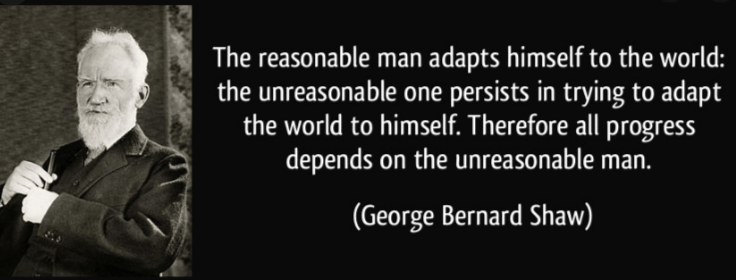
Think about this: What’s the point of a band covering a song if they don’t change it up and put their own spin on it? So, I suggest: Look at what is, but find a way to see beyond that and run with it. Robert Kennedy’s paraphrasing of a George Bernard Shaw quote is quite fitting: “There are those that look at things the way they are, and ask why? I dream of things that never were, and ask why not?” And I ask: Which will you be?
Dr. Bert Shlensky, president of Startup Connection (www.startupconection.net) is a graduate of Sloan School of Management at M.I.T. He served as the president of WestPoint Pepperell’s apparel fabrics business as well as the President & CEO of Sure Fit Products. Having provided counseling to over 2,000 clients, he now focuses on working with select startups and small businesses.
Risk is a critical part of every decision. And, frankly, I think we all need more of it. We tend to think of risk as a taboo concept and it’s really not—once you understand it.
In order to benefit from risk, you need to define what risk is to you. Some people view risk as the “potential for harm or hazard” (think bungee jumping). I view risk as an “uncertain circumstance in which one manages to maximize the gains.” But, how do you maximize the probability of success?
Here are some key parameters that affect risk-based decisions:
Consider conditions. For example, you have almost certain probability that, in general, October will be cooler than September. However, forecasting a certain day adds risk and uncertainty.
Reduce risk where you can to allow even more risk in other areas. For example, more analytics in sports is creating opportunities to assess strengths/weaknesses and create new winning strategies. It has enabled athletes to take more three-point shots, hit more home runs and longer golf drives, and score more touchdowns. Similarly, surfers used to ride 29-30 waves and now they are comfortable in 50 to 80-foot waves. Jet Ski rescues, inflatable vests, and leashes are among the tools that reduce uncertainty and increase potential.
Know the value and probability of the reward. Winning the lottery has an extremely high reward, but also has low probability. Purchasing investment bonds has lower return than buying stocks, but the risk and volatility of buying stocks is higher.
Value is also affected by the law of diminishing returns, which states that: as the input or value increases, the incremental changes become less important. It is easily summarized by the old saying, “Too many cooks spoil the broth.” Other examples include adding superfluous benefits to an offer, endless presentations, annoying excessive service, or just making the reward dramatically above what is needed or desired. Let’s say you love pie, but only have it once in a while as a treat. In this instance, the value is higher. But, if you eat it every day, it becomes less special and the value decreases. The same goes for a visit with your in-laws: Once a month is good, one a week might be less good, and every day might really be pushing it…
Understand the perceived importance of the reward. People generally regret losses more than they appreciate gains—and that is a key factor to consider when making any decision. When choosing a college to attend, decisions depend on area of course study, school size, location, tuition, the school’s reputation, etc. Are some of these factors more important than others? It varies depending on the individual.
The benefits from risk are a result of integrating the above examples to maximize results. Let’s look at the game of craps as an example: When you roll two dice, there is over a 40% probability you will roll a 6, 7, or 8 and about a 6% probability you will roll a 2 or a 12. So, if you’re placing a bet, knowing the odds (i.e. the probability of the reward) will reduce the risk. Betting is based on your willingness to risk in order to earn higher or lower rewards. The most forgotten aspect of craps (and all betting, for that matter) is that, over the long run, the house wins which is why casinos are so profitable.
Risk needs to managed rather than feared. Understanding the risk, the rewards, and the importance of each can help you improve outcomes. Don’t allow fear, uncertainty, or tradition to lower your potential and prevent you from trying something new. Only those who dare to risk going too far can find out how far one can go.
Key factors to consider to increase the benefits from risk:
Understand all the information. Knowing background, probabilities, and parameters can greatly enhance outcomes. For instance, investment decisions are greatly influenced by history and trends. However, because there is so much change due to the pandemic, the risk is now more volatile and opportunistic. Knowing the circumstances around your decisions is key.
Psychology. Assessing risk has a number of psychological constraints: a) People tend to take more risks to win back losses and less risks to follow up on winnings. b) Marketers love to push fear. When you are buying a car, appliance etc., they push its safety, reliability, and excellence. After you commit, they try selling a warranty. They induce fear by citing all the things that can go wrong. c) We overestimate our skills and luck. Tons of profits are made at casinos and in sports betting based on countless people believing that they can beat the odds.
Think about your decisions and the outcomes. We often perceive decisions as win-lose situations where one-party wins and another loses, but there are different types of decisions. Changing that mentality to “win-win” can have dramatic benefits and we tend to underestimate the opportunities we have to achieve this. For example, who would have believed decades ago that the mergers of Vietnam and Germany would be so successful? So, when making a choice, brainstorm ways to maximize benefits all around.
Rethink your strategy: Zero sum game versus non zero-sum game. Which are you employing? The best negotiations result in both parties winning. This takes collaboration, assessing varying (or even opposing) goals, and increasing the metaphorical “pie.” In particular, try to understand what is important and unimportant for each party involved. For example, many traditional retailers viewed online shopping as a liability in terms of disrupting their regular business. Now, they’re viewing it as a savior, recognizing it’s a safe and effective way to meet the needs of their consumers.
Risk mitigation. The best, simplest, inexpensive, and most effective way to mitigate risk is to gather more information. The more you know about making a decision, the less risk it will involve. Other tools include: insurance, diversification, and leverage. One of the challenges of mitigation is that people often use it to take even more risk and that defeats the purpose.
Listen to your gut. Sometimes you just have to ignore some of the information and go for it. We tend to overthink things or we let fear stop us from taking risks, but there is no gain without trying and no reward without risk. If your intuition is telling you something, it’s usually worth listening.
Risk needs to managed rather than feared. Understanding the risk, the rewards, and the importance of each can help you improve outcomes. Don’t allow fear, uncertainty, or tradition to lower your potential and prevent you from trying something new. Only those who dare to risk going too far can find out how far one can go.
Search
Startup Connection
When you want to stand out, reach out to Bert for the tools that will build your “sticky” brand. My focus is on understanding and analyzing your dilemmas and challenges, so your company becomes profitable faster.
Call (914) 632-6977 or email me at bshlensky@startupconnection.net. Don’t leave without signing up for our useful free eBook!
Feeling stumped or overwhelmed? Contact Bert at (914) 632-6977 or Email to start the process. Thanks!
“
Donec sollicitudin molestie malesuada. Vestibulum ac diam sit amet quam vehicula
Cras ultricies ligula sed magna dictum porta. Curabitur arcu erat, accumsan id imperdiet et, porttitor at sem. Vivamus magna justo, lacinia eget consectetur sed, convallis at tellus. Donec sollicitudin molestie malesuada. Mauris blandit aliquet elit, eget tincidunt nibh pulvinar a. Pellentesque in ipsum id orci porta dapibus. Vivamus suscipit tortor eget felis porttitor volutpat. Vestibulum ac diam sit ame
When it comes to collaboration, words like support, positive feedback, communication, listening, and mentoring permeate the conversation. However, competition and conflict can also benefit collaboration. Being agreeable and complimentary are all well and good, but we...
Currently, everyone seems overwhelmed with stress, change, complexity, uncertainty, and disruption. The pandemic, inflation, politics, crime, and a general increase in depression are all taking a toll on us individually and as a society. With so much on our plates in...
When we consider risk, much of the discussion revolves around analytics, alternatives, probability, and bias. But, there are other important factors to consider, which are frequently excluded and, when dealt with properly, can create new opportunities. These include...
Stay Up to Date With The Latest News & Updates
Access Premium Content
Sed ut perspiciatis unde omnis iste natus error sit voluptatem accusantium doloremque
The pandemic has caused some chaos, to say the least. The uncertainty and severity of the situation has caused most of us to shift focus, reconsider our efforts and priorities, and question risk. As a result, it’s critical to reexamine how to maximize opportunities, results, and challenges. While there’s still plenty of unpredictability, there are several clear rules to follow that will help you prioritize and improve results.
I believe the 80-20 rule (which states 80% of results are from 20% of sales) is one of the most useful guidelines. Reassess and renew efforts on programs that have the most potential. But, it is equally important to eliminate unproductive efforts.
Bigger is getting more important: For example, between 40-50% of online consumer sales are on Amazon. You can’t ignore that impact and its affect on results.
Prioritize innovation. Culture, execution, measurement, marketing, and operations are critical elements that support success from innovation.
Learn to prioritize more effectively. Focus on what you’re good at and pay less attention to your weaknesses. For example, I have a client who has the best product in the industry, but charges a little more money. She has achieved success by moderating some prices, but mostly by developing messaging that explains her quality difference.
Limit objectives to a handful. Limiting strategic priorities allows you to focus on what matters most. It can also serve as a way to drive a decision when faced with difficult trade-offs, which can also increase results. We are frequently encouraged to develop multiple alternatives; yet, spending time on weak alternatives can be extremely wasteful.
Make the hard decisions. We need to be flexible in order to evaluate alternatives and respond to change, but we also need to make firm choices to manage challenges and trade-offs.
Address critical vulnerabilities. We tend to focus on strengths and opportunities and ignore challenges, but this can lead to neglecting a vital aspect of a plan. For example, logistics, customer service, and safety are frequently overlooked, but they can provide important differentiation that will make your business stand out.
Provide specific action plans. They should be concrete enough that participants throughout the organization can understand what to focus on and what to avoid.
Eliminate costly and unproductive activities. This is key. Consider cell phones, email, social media, and the Internet: Most of it is time-consuming junk that can be eliminated or reduced (or, at least, not viewed every minute of the day). Develop a master list of activities and then categorize them into areas like: urgent, maintenance versus development, cost, risk, results, probability of success etc. This will help you see which activities need more focus and which need less as you prioritize.
Consider culture. It’s a critical component of establishing priorities. Sometimes, “now is not the time” is an appropriate response. Other times, opportunities for change are required and you need to be as prepared as possible. For example: Issues like safety, stress, and uncertainty have become critical elements and adapting to the pandemic is unavoidable.
Opportunities to expand your market will arise—so keep the 80-20 rule in mind as things change. Some efforts could be declining while new critical opportunities may be emerging. These instances are worth serious consideration—especially when the investment is minor. You may open up a door to a broader 20 percent.
So remember: prioritization can produce dramatic results. Spend more time analyzing your priorities and watch how that affects your results.
Dr. Bert Shlensky, president of Startup Connection (www.startupconection.net) has an MBA and PhD from the Sloan School of Management at M.I.T. He served as the president of WestPoint Pepperell’s apparel fabrics business, and President and CEO of Sure Fit Products. Having provided counseling to over 2,000 clients, he now focuses on working with select start-up and small businesses.
When you want to stand out, reach out to Bert for the tools that will build your “sticky” brand. My focus is on understanding and analyzing your dilemmas and challenges, so your company becomes profitable faster.
Call (914) 632-6977 or email me at bshlensky@startupconnection.net. Don’t leave without signing up for our useful free eBook!
Feeling stumped or overwhelmed? Contact Bert at (914) 632-6977 or Email to start the process. Thanks!